The Most Iconic Australian Children’s Book Characters (And Why They Still Matter)
Snugglepot and Cuddlepie were born in 1918. Blinky Bill arrived in 1933. Grug turned up in 1979. Hush and Grandma Poss came along in 1983.
More than forty years separate the oldest from the newest on that list, and every single one of them is still in print.
That’s not luck. Australian children’s literature has produced a handful of characters so well-drawn, so rooted in something real, that they’ve outlasted the generations that first read them. If you’re building a bookshelf for a child, understanding what makes these characters work is genuinely useful.
This is a guide to the most iconic Australian children’s book characters: what they are, why they’ve lasted, and which ones suit which ages.
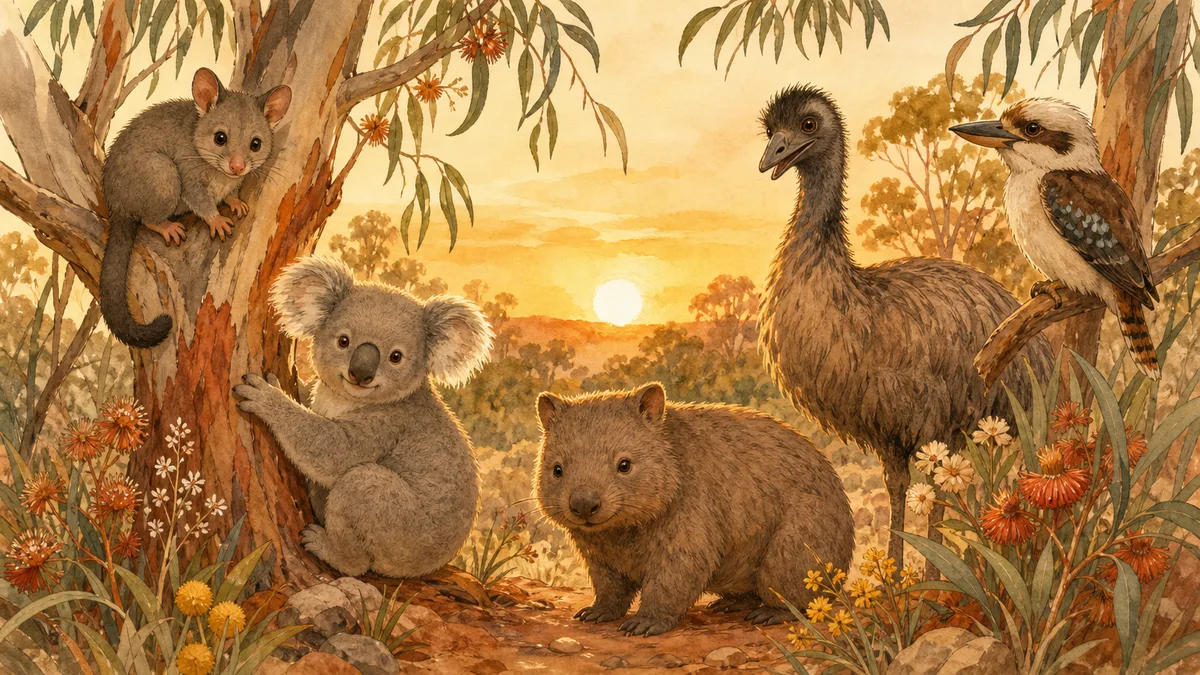
Australia’s bush and wildlife are the raw material behind its most enduring book characters.
What makes an Australian children’s book character iconic?
An iconic Australian children’s book character reflects something true about Australian life, usually the bush or the wildlife, while solving a problem any child recognises. The best of them don’t require explanation. A child picks up the book and immediately sees something of themselves: the curiosity, the awkwardness, the small daily problem that feels enormous when you’re four years old.
The characters on this list share a few things. They’re grounded in a specific place, usually the Australian bush or the natural world. They face small, concrete challenges rather than grand adventures. And they never talk down to the child reading them.
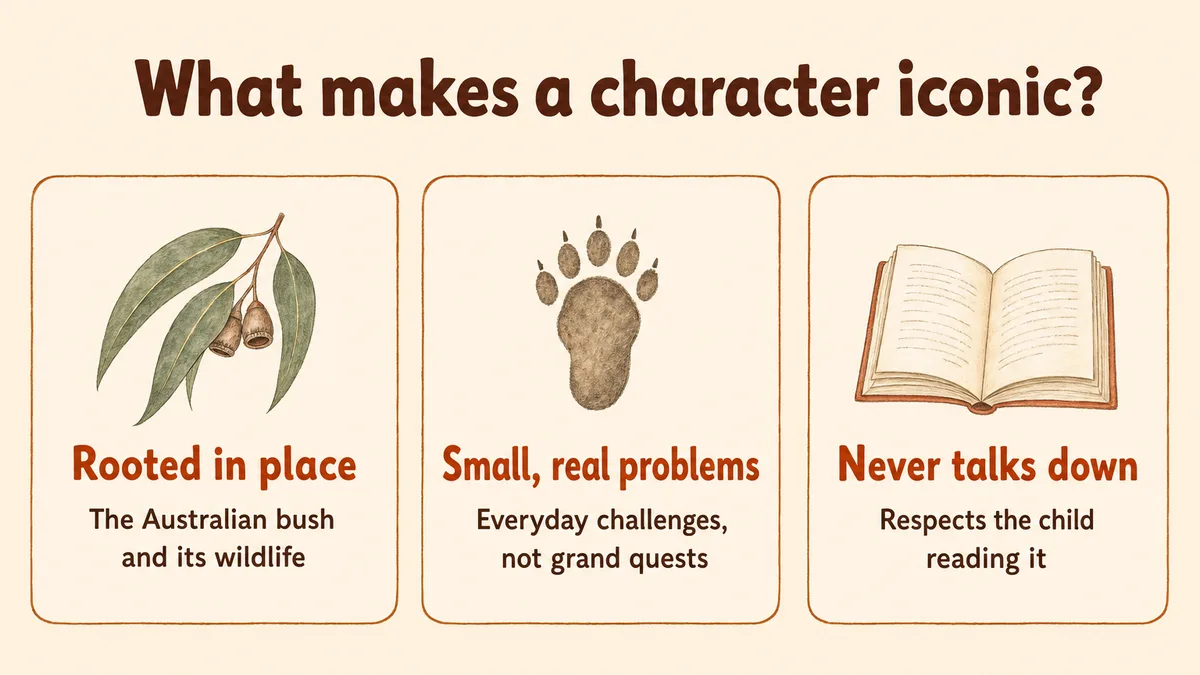
The three traits the most enduring Australian characters share.
The classics: characters that shaped Australian childhood (1918–1979)
Snugglepot and Cuddlepie
May Gibbs published Snugglepot and Cuddlepie in 1918, and it is difficult to overstate how different it was. Before Gibbs, Australian children’s books largely imported their characters from England: rabbits in coats, hedgehogs with umbrellas, that sort of thing. Gibbs looked at the gum trees outside her window and saw faces.
Snugglepot and Cuddlepie are gumnut babies, tiny figures born from the seed pods of eucalyptus trees, going on adventures through the Australian bush and running into the fearsome Banksia Men. They’re not tame. Gibbs gave them real danger to navigate, real consequences. The illustration style is detailed and strange and entirely unlike anything that came before it in Australian publishing.
They’ve since appeared on postage stamps, a ballet, and multiple stage shows. The books are still in print, more than a century later.
Best for: Ages 3–7. The picture books suit young readers; the original chapter book works well for confident readers aged 8+.
Albert from The Magic Pudding
Norman Lindsay’s The Magic Pudding (1918, the same year as Snugglepot, a remarkable year for Australian children’s literature) introduced Albert, a pudding who is argumentative, self-important, and refuses to be eaten politely.
Albert isn’t the protagonist (Bunyip Bluegum the koala is), but Albert is the character everyone remembers. There’s something distinctly Australian about a character whose defining trait is refusing to do what he’s told. Lindsay’s satire of adult pretension, filtered through talking animals and a magic food source, has aged better than most children’s books of its era.
Best for: Ages 5–8. More text than illustration; rewards being read aloud.
Blinky Bill
Dorothy Wall’s Blinky Bill (first book, 1933) is a mischievous koala living in a country town called Greenpatch. He gets into trouble constantly. He means well — usually. He is, above all else, recognisable: any child who has ever pushed a boundary they knew they shouldn’t will find something familiar in him.
Wall published three Blinky Bill books before her death in 1942. They’ve been adapted into animated series twice, a feature film, and numerous stage productions. The original books can feel dated in places, but the character himself — curious, stubborn, a little chaotic — has worn well.
Best for: Ages 4–8.
These three are where the canon begins. For the books themselves rather than the characters behind them, see our guide to classic Australian children’s books.
Who is Grug?
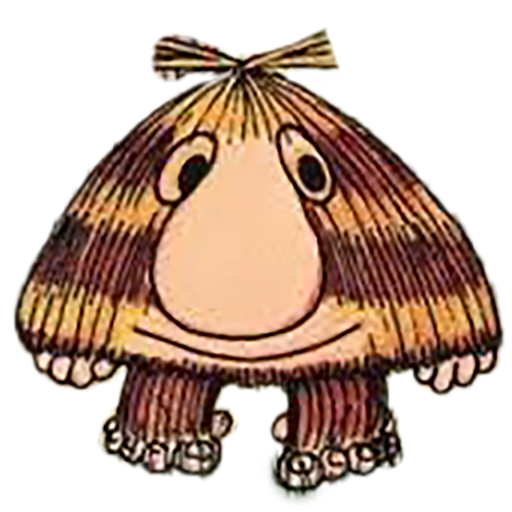
Grug is a small creature who lives in the Australian bush. He was created by Ted Prior in 1979, and the idea grew from a simple observation: what if a Burrawang palm top fell to the ground and started wondering about the world?
That’s Grug. He’s striped, round-ish, somewhere between a haystack and a grass tree. He has no visible mouth in the illustrations, but his expressions are completely readable. In each of the 47 books, Grug faces a specific, concrete challenge — learning to swim, making friends, dealing with fear — and works through it without drama.
What makes Grug distinctive among Australian children’s book characters is the quietness. No villain, no grand danger, no triumphant fanfare. Grug figures something out. That’s the whole book. And for a child aged two or three, watching someone their size work through a problem calmly is exactly what they need.
Grug, created by Ted Prior in 1979 from the fallen top of a Burrawang palm.
The series ran from 1979 to 1992, was adapted for television, and has been in continuous print since Simon & Schuster republished the complete series in 2009. There are board book editions for very young readers, picture books for toddlers and preschoolers, and a complete collection box set.
Grug is one of the few Australian children’s book characters with a book for virtually every situation a small child encounters. That’s 47 books of practice.
Best for: Ages 0–6. Board books from birth; picture books from around 18 months.
See the full list of Grug books →
The 1980s wave: when Australian picture books went global
Hush and Grandma Poss from Possum Magic
Mem Fox and Julie Vivas published Possum Magic in 1983. It has since sold over 3.5 million copies, the best-selling Australian children’s picture book ever printed.
Grandma Poss uses bush magic to make her granddaughter Hush invisible. Then, having forgotten the reversal spell, they travel around Australia eating local foods until they find the one that makes Hush visible again. The conceit is simple. The execution — Fox’s rhythmic, exact text alongside Vivas’s loose watercolours — is anything but.
Hush is a character defined by a problem she didn’t choose and can’t solve alone. Grandma Poss is defined by love expressed through imperfection. That combination hits differently than the usual children’s book setup, which is probably why parents read it as enthusiastically as their children do.
Best for: Ages 2–6.
Koala Lou
Also Mem Fox (1988). Koala Lou is about a young koala who desperately wants to win the Bush Olympics — to hear her mother say “I love you” again. She trains hard. She doesn’t win. Her mother says it anyway.
It is one of the most honest books about childhood anxiety ever written for picture book age. Fox manages it in under 500 words.
Best for: Ages 3–6.
Edward the Emu
Sheena Knowles and Rod Clement’s Edward the Emu (1988) follows an emu who is bored with being an emu and tries being a snake, a seal, and a lion, before deciding that being an emu is actually fine. It’s funny. Clement’s illustrations of Edward attempting to impersonate other animals are genuinely amusing for adults reading it for the fifteenth time.
Edward the Emu spawned a sequel, Edwina the Emu, and has remained in print for nearly forty years.
Best for: Ages 3–6.
The characters keeping the tradition alive today
The wombat from Diary of a Wombat
Jackie French and Bruce Whatley published Diary of a Wombat in 2002. The wombat has no name. She has a weekly diary consisting almost entirely of sleeping, eating, and demanding things from the humans who’ve moved nearby.
The joke is sustained for exactly the right amount of time. The wombat is completely satisfied with a life of radical simplicity, and the humans are slowly trained to deliver oats on demand. Children find this hilarious. Adults find it uncomfortably relatable.
The series has grown to multiple books and is regularly cited as a modern classic of Australian children’s literature.
Best for: Ages 3–7.
Bluey
Bluey started as a television series (2018) before moving into books. The picture book adaptations have become the fastest-growing segment of Australian children’s publishing.
Bluey is a Blue Heeler puppy living in Brisbane with her family. The stories are about play, imagination, and family dynamics. The reason they work for books as well as television is that the emotional content is strong enough to carry without animation, which is not always true of TV-to-book adaptations.
Whether Bluey qualifies as a “book character” in the traditional sense is debatable. She was a TV character first. But the books have found a genuine audience, and her presence on bookshelves across Australia is real.
Best for: Ages 2–6.
Which character is right for your child’s age?
| Age | Character | Format |
|---|---|---|
| 0–2 | Grug (board books) | Board book |
| 0–2 | Where is the Green Sheep? (Mem Fox) | Board book |
| 2–4 | Grug, Bluey, Snugglepot & Cuddlepie | Picture book |
| 3–6 | Possum Magic, Koala Lou, Edward the Emu | Picture book |
| 4–7 | Blinky Bill, Diary of a Wombat | Picture book / early reader |
| 5–8 | Albert from The Magic Pudding | Read-aloud / early chapter |
| 6–8+ | Snugglepot & Cuddlepie chapter books | Chapter book |
Frequently asked questions
What is the most famous Australian children’s book character of all time?
By sales, Hush from Possum Magic (Mem Fox, 1983) is the benchmark, with over 3.5 million copies sold. By cultural longevity, Snugglepot and Cuddlepie (May Gibbs, 1918) have been continuously in print for over a century. Both have a reasonable claim to the title.
What Australian children’s book has sold the most copies?
Possum Magic by Mem Fox and Julie Vivas, with over 3.5 million copies sold since 1983. It remains Australia’s best-selling children’s picture book.
Who created Grug?
Grug was created by Australian author and illustrator Ted Prior. The first book was published in 1979. Prior drew inspiration from the fallen top of a Burrawang palm, which reminded him of a small creature peering at the world. He published 47 books in the series, along with an animated television series that aired in the 1980s.
Are Australian children’s book characters based on real animals?
Most of the iconic ones are. Blinky Bill is a koala. Hush and Grandma Poss are possums. The Diary of a Wombat character is a wombat. Edward is an emu. Even Snugglepot and Cuddlepie, fantastical as they are, are drawn from the seed pods of real Australian eucalyptus trees. The natural world is the source material for almost the entire Australian children’s book canon, which is part of why these characters feel so grounded.
If you’re starting a shelf of Australian children’s books for a child under five, Grug is a good place to begin. Forty-seven books, forty-five years in print, and still one of the quietest and most honest accounts of what it’s like to be small and figuring things out.