Classic Australian Children’s Books: The All-Time List
A book has to earn the word “classic.” Plenty of children’s books sell well for a year or two and then disappear. A classic does something harder: it survives the children who first read it, gets handed to their children, and somehow still works.
Australia has produced a surprising number of them for a country its size. Some are more than a century old and have never gone out of print. This is a guide to the classic Australian children’s books that have lasted: what each one is, why it endures, and which age it suits. Not a ranked countdown. A shelf worth building, organised by the era that produced it.
The classics earn the word by staying in print across generations.
What makes an Australian children’s book a classic?
A classic Australian children’s book is one that’s stayed in print across generations, is rooted in something genuinely Australian — the bush, the wildlife, the way the place feels — and still reads well to a child today. Sales help, but the real test is longevity. A classic is a book a grandparent and a grandchild both know.
That last point matters more than people think. A lot of “best of” lists are really lists of books that sold well last Christmas. The titles below have cleared a higher bar. The youngest of them has been in print for over twenty years. The oldest, well over a hundred.
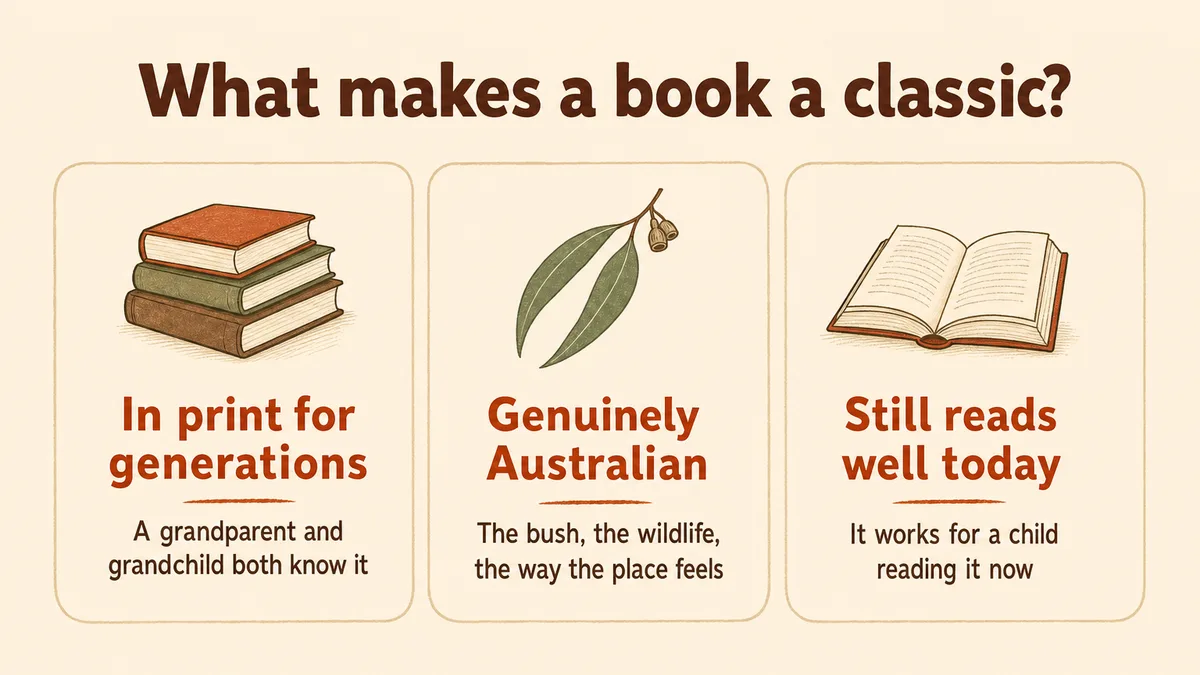
Longevity, not last Christmas’s sales, is the real test.
The foundational classics (1840s–1930s)
This is where the canon starts. Before these books, Australian children mostly read imported stories: English rabbits, English hedgehogs, English weather. These authors looked out the window and wrote what they actually saw.
Australia’s first children’s book is usually dated to 1841: A Mother’s Offering to Her Children by Charlotte Barton, published anonymously by “A Lady, long resident in New South Wales.” It’s a curiosity now more than a read-aloud. The books that genuinely founded the tradition came a little later.
Seven Little Australians (1894)
Ethel Turner’s novel about the seven Woolcot children is the oldest Australian children’s book still widely read. It’s also unusual for its time in refusing to be tidy: there’s a death near the end that generations of readers have never quite recovered from. Turner wrote about real Australian children behaving like real children, which in 1894 was close to radical.
Best for: Ages 9+ as a read-alone; younger as a read-aloud or via the screen adaptations.
Dot and the Kangaroo (1899)
Ethel C. Pedley’s story of a lost little girl helped through the bush by a mother kangaroo was one of the first books to put native animals at the centre rather than the edge. There’s an environmental conscience running through it that was decades ahead of its time. The 1977 animated film introduced it to a second century of children.
Best for: Ages 5–8.
Snugglepot and Cuddlepie (1918)
May Gibbs’s gumnut babies are arguably the most important characters in the whole tradition. Gibbs took the seed pods of the eucalyptus and turned them into tiny people, gave them the Banksia Men to fear, and built an entire bush world that felt unmistakably Australian. Tales of Snugglepot and Cuddlepie has never been out of print. That’s over a century of continuous publication.
Best for: Ages 3–7 for the picture editions; 8+ for the original chapter book.
The Magic Pudding (1918)
Norman Lindsay published this the same year as Snugglepot, a remarkable twelve months for the country. It follows Bunyip Bluegum the koala, Bill Barnacle the sailor, and Sam Sawnoff the penguin as they defend Albert, a bad-tempered pudding who can never be finished and never stops complaining. It’s funny in a dry, contrary way that reads as distinctly Australian. Adults often enjoy it more than children.
Best for: Ages 5–8, best read aloud.
Blinky Bill (1933)
Dorothy Wall’s mischievous koala has been adapted for television twice and film once. The original books can feel a little of their era, but Blinky himself — curious, stubborn, always in trouble he half-meant to start — has aged better than the prose around him.
Best for: Ages 4–8.
For more on the characters behind these books and why they’ve lasted, see our guide to iconic Australian children’s book characters.
The mid-century classics (1960s–1970s)
Quieter decades for picture books, but they produced a few titles that belong on any serious list.
The Muddle-Headed Wombat (1962)
Ruth Park’s scatterbrained wombat began on radio before becoming a long-running series of books. Gentle, funny, and very Australian in its affection for a well-meaning character who gets everything slightly wrong.
Best for: Ages 5–8.
Storm Boy (1964)
Colin Thiele’s novella about a boy living on the Coorong with his father and a pelican named Mr Percival is one of the most loved Australian books for older children. It’s short, it’s sad in the way the best children’s books are willing to be, and the 1976 film cemented it. If you want a book that takes a child seriously, this is it.
Best for: Ages 8–12.
The Rainbow Serpent (1975)
Dick Roughsey’s retelling of the Lardil creation story won the CBCA Picture Book of the Year in 1976 and remains one of the most important Indigenous-authored picture books in print. It belongs on this list not as a token but because it’s genuinely a classic. The artwork alone earns its place.
Best for: Ages 5–9.
The modern classics (1979–1986)
This is the stretch that produced the books most Australian parents under fifty actually grew up with. A real golden run.
Grug (1979)
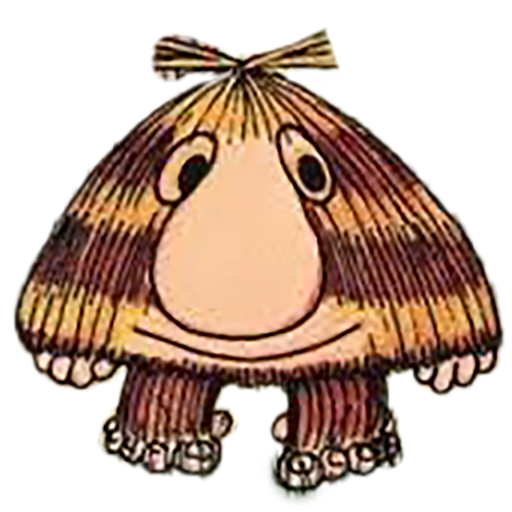
Ted Prior created Grug from the fallen top of a Burrawang palm: a striped, round little creature, somewhere between a haystack and a grass tree, who lives in the bush and works through one small problem per book. Learning to swim. Making a friend. Being scared of the dark. No villains, no fanfare. Grug figures it out, and that’s the book.
Grug, created by Ted Prior in 1979 from the fallen top of a Burrawang palm.
That quietness is exactly why it works for the very young. For a two-year-old, watching someone their own size calmly solve a small problem is the whole point. The series ran to 47 books and has been continuously in print since Simon & Schuster republished the complete set in 2009, including board books for babies and a box set.
Best for: Ages 0–6. Board books from birth, picture books from around 18 months.
See the full list of Grug books →
Who Sank the Boat? (1982)
Pamela Allen’s deceptively simple picture book — a cow, a donkey, a sheep, a pig and a tiny mouse climbing into a boat — teaches cause and effect, balance, and comic timing without ever feeling like a lesson. It reads aloud beautifully and has stayed in print for over forty years.
Best for: Ages 2–5.
Possum Magic (1983)
Mem Fox and Julie Vivas made the best-selling Australian children’s picture book ever printed, over 3.5 million copies. Grandma Poss makes her granddaughter Hush invisible with bush magic, then can’t undo it, so they travel the country eating Australian foods until the right one brings her back. Fox’s rhythmic text and Vivas’s loose watercolours are a near-perfect match.
Best for: Ages 2–6.
Wombat Stew (1984)
Marcia Vaughan and Pamela Lofts gave Australia a dingo trying to cook a wombat and a chorus of bush animals sabotaging the recipe. The repeated “wombat stew, wombat stew” refrain is the kind of thing children chant for days. A staple of Australian preschools for good reason.
Best for: Ages 3–6.
Animalia (1986)
Graeme Base’s alphabet book is in a category of its own: densely illustrated, packed with hidden objects, the sort of book a child returns to for years and keeps finding new things in. Less a story than a world to get lost in.
Best for: Ages 4+ (and adults).
A good number of these are bush-and-animal books, which is no accident. That thread runs through the whole tradition. We cover it on its own in our guide to Australian children’s books about animals and the bush.
The two newer classics worth adding
Two more recent titles have earned the word already. Jackie French and Bruce Whatley’s Diary of a Wombat (2002) — a wombat whose week consists of sleeping, eating, and training the neighbours to deliver oats — and Mem Fox and Judy Horacek’s Where Is the Green Sheep? (2004), which has become one of the most reliable first books for babies in the country.
Picture books or chapter books? A quick guide by age
The word “classic” covers everything from board books to full novels here. Rough guide to what suits when:
| Age | Start with | Format |
|---|---|---|
| 0–2 | Grug board books, Where Is the Green Sheep? | Board book |
| 2–5 | Who Sank the Boat?, Grug, Possum Magic | Picture book |
| 3–6 | Wombat Stew, Diary of a Wombat | Picture book |
| 4–8 | Animalia, Blinky Bill, The Rainbow Serpent | Picture book / early reader |
| 5–8 | The Magic Pudding, The Muddle-Headed Wombat | Read-aloud / early chapter |
| 8–12 | Storm Boy, Seven Little Australians | Chapter book / novel |
Where to buy classic Australian children’s books
Almost everything on this list is still in print, which is the upside of buying classics: you rarely have to hunt. New copies are stocked by Australian booksellers like Dymocks, QBD and Booktopia, and by the publishers directly. For the Grug series, Simon & Schuster Australia carries the full range, including the board books and the complete box set.
Secondhand is worth a look for the older titles, especially early editions of Snugglepot and Cuddlepie or The Magic Pudding, where the original illustrations are part of the appeal. Just check the condition. These get loved hard.
Frequently asked questions
What is the most famous Australian children’s book?
Two have a strong claim. By sales, Possum Magic by Mem Fox (1983) is the benchmark, with over 3.5 million copies sold, the best-selling Australian children’s picture book ever. By age and cultural standing, May Gibbs’s Snugglepot and Cuddlepie (1918) has been in print continuously for more than a hundred years.
What was the first Australian children’s book?
A Mother’s Offering to Her Children, published anonymously in 1841 and generally attributed to Charlotte Barton, is usually named as the first children’s book written and published in Australia. It reads more as a historical document now than a bedtime story.
What is the best-selling Australian children’s book?
Possum Magic by Mem Fox and Julie Vivas, with more than 3.5 million copies sold since 1983. No other Australian children’s picture book has matched it.
What makes a children’s book a “classic”?
Longevity, not popularity. A classic stays in print across generations and still reads well to children long after it was written. The books on this list range from twenty years old to over a century, and every one of them is still being bought new today.
Are these classic books still in print?
Almost all of them. Snugglepot and Cuddlepie, The Magic Pudding, Possum Magic, Grug and most of the modern titles are widely available new from Australian booksellers. A few older novels turn up most reliably secondhand, but nothing on this list is truly hard to find.
If you’re building a first shelf of classics for a child under five, Grug is a sensible place to start: 47 books, more than forty years in print, and still one of the quietest, most honest accounts of what it’s like to be small and working something out.