CBCA Australia Awards: A Parent’s Guide to the Book of the Year
You’ve seen the sticker. A gold or silver foil circle on the front of a picture book, sometimes at the library, sometimes on the shop table near the register. It says “CBCA” and “Book of the Year.” Most parents grab the book, never quite sure what the sticker means, only that it seems to mean something good.
It does, and it’s worth more than most people realise. The Children’s Book Council of Australia awards are the oldest and most trusted book prizes in the country, and that little foil circle is one of the few shortcuts a busy parent actually has when buying Australian children’s books. This is a guide to what the awards are, the categories they cover, how the books get chosen, and why the sticker is worth a second look. We’re a Grug fan site, so we’ve followed these awards closely for a long time. Here’s what they actually tell you.
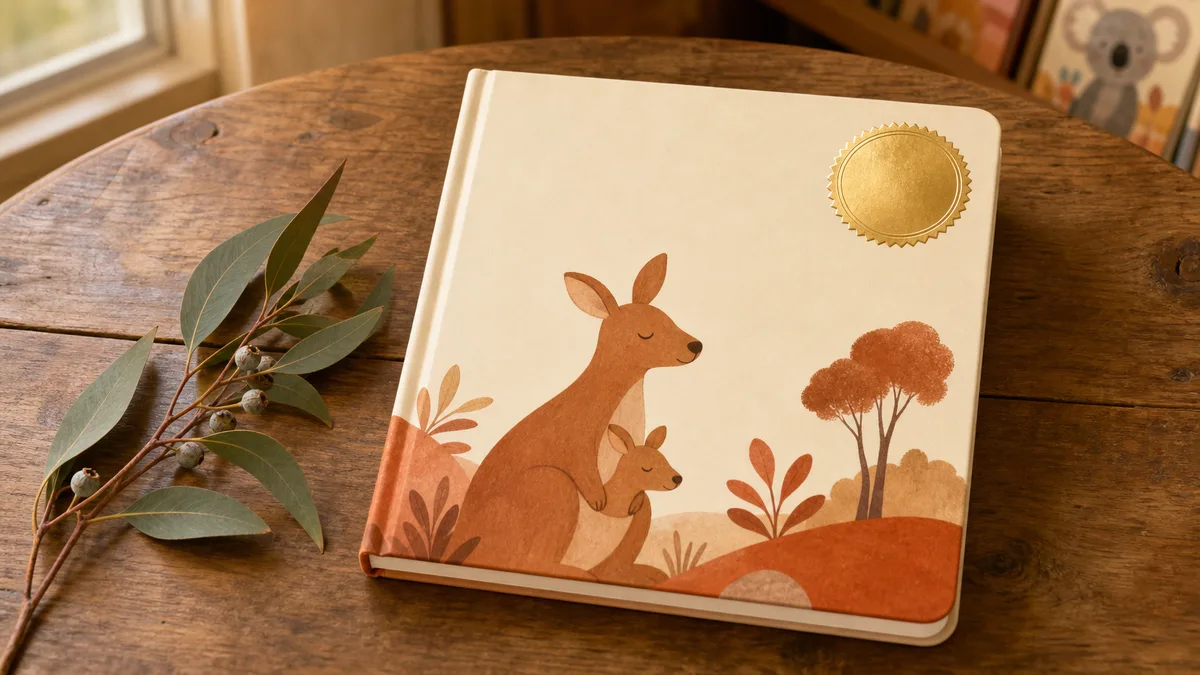 That gold seal is the closest thing a busy parent has to a trustworthy filter.
What are the CBCA Book of the Year Awards?
The CBCA Book of the Year Awards are Australia’s longest-running children’s book prizes, awarded every year since 1946 by the Children’s Book Council of Australia to recognise the best books for young Australians written and illustrated by Australians. Books are entered by their publishers, read by a panel of volunteer expert judges, and the winners are announced each August during Children’s Book Week.
The Council itself goes back to 1945, when the first Children’s Book Week was held across the country. The award followed a year later. That makes 2025 the eightieth year of Book Week, which the CBCA marked with the theme “Book an Adventure!” Eighty years is a long time for any award to stay relevant, and the reason it has is simple: it has never been a popularity contest. A book that sells a million copies can miss the shortlist entirely, and a quiet book from a small press can take the top prize.
The six award categories
The award isn’t one prize. It’s six, each pitched at a different age or kind of book, so a board book for a one-year-old and a novel for a teenager aren’t forced to compete. Knowing the categories is the fastest way to read the sticker: it tells you who the book is for.
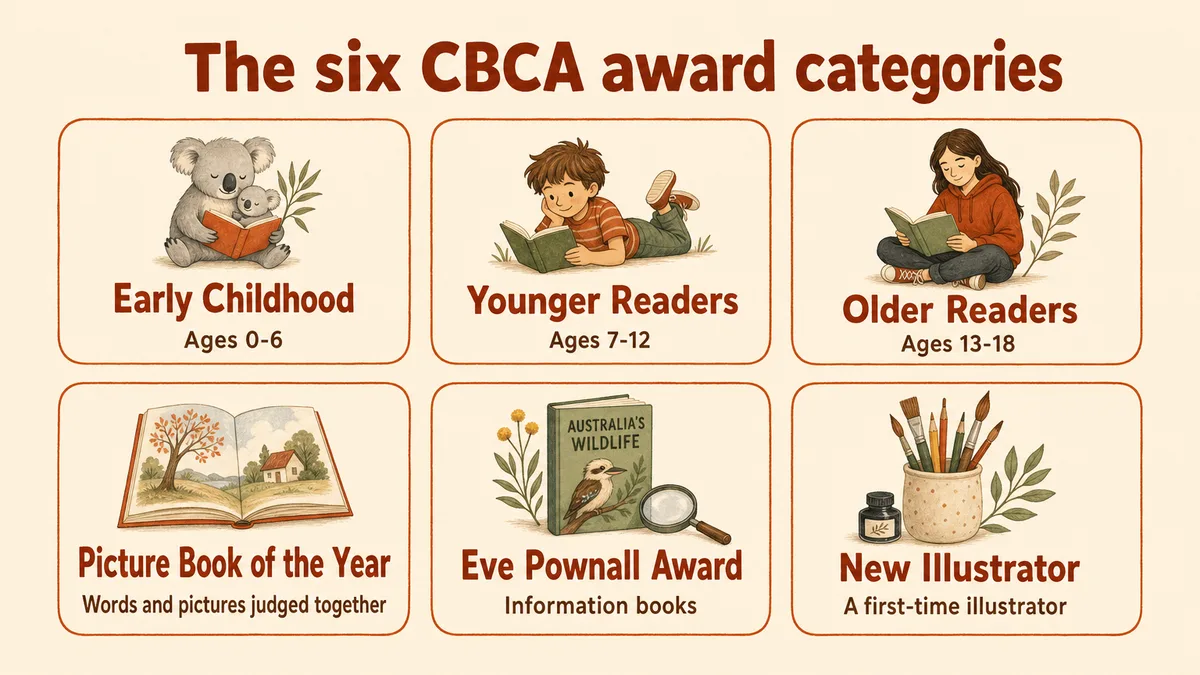 Six categories, one per age or kind of book, so a board book never competes with a teen novel.
Book of the Year: Older Readers is for secondary-school readers, roughly ages 13 to 18. Fiction, drama, or poetry that deals with the bigger, harder stuff teenagers are ready for. The 2025 winner was I’m Not Really Here by Gary Lonesborough.
Book of the Year: Younger Readers covers the middle to upper primary years, around ages 7 to 12. These are the chapter books and longer stories kids read once they’re reading on their own. Laughter Is the Best Ending by Maryam Master, illustrated by Astred Hicks, won in 2025.
Book of the Year: Early Childhood is the one most relevant if you’ve got a toddler or preschooler, ages 0 to 6. It’s where simple, read-aloud stories live. The 2025 winner, The Wobbly Bike by Darren McCallum and illustrator Craig Smith, is exactly the kind of book a four-year-old asks for on repeat.
Picture Book of the Year is judged differently from the rest. Here the words and the pictures are weighed together as one work, so the illustrator matters as much as the writer. It runs across the full age range, 0 to 18, because a picture book isn’t only for the very young. The Truck Cat by Deborah Frenkel, illustrated by Danny Snell, took the 2025 prize. If you want to go deeper on this category, our guide to the best Australian picture books picks up where the awards leave off.
The Eve Pownall Award is for information books, the factual ones that teach a child about the world. Named after the author and historian Eve Pownall, it’s the category that rewards a well-made book about bugs or rivers or history as highly as any novel. In 2025 it went to Always Was, Always Will Be by Aunty Fay Muir and Sue Lawson.
The Award for New Illustrator does one specific job: it finds someone at the start of their career. You can only win it once, early, which is the point. The 2025 winner was Sarah Capon for Grow Big, Little Seed, written by Bec Nanayakkara.
How the books actually get chosen
Here’s the part that surprises people. Nobody at the CBCA buys these books or runs a marketing budget for them. Publishers enter their own titles, and then a panel of judges reads everything.
And it really is everything. In 2025, fifteen judges worked through 730 entries. That’s not a skim. The judges sit for two-year terms in their category, and they’re volunteers, reading on their own time from the moment the first parcels of books land on their doorsteps. They meet through the year, argue it out, and narrow the field in stages.
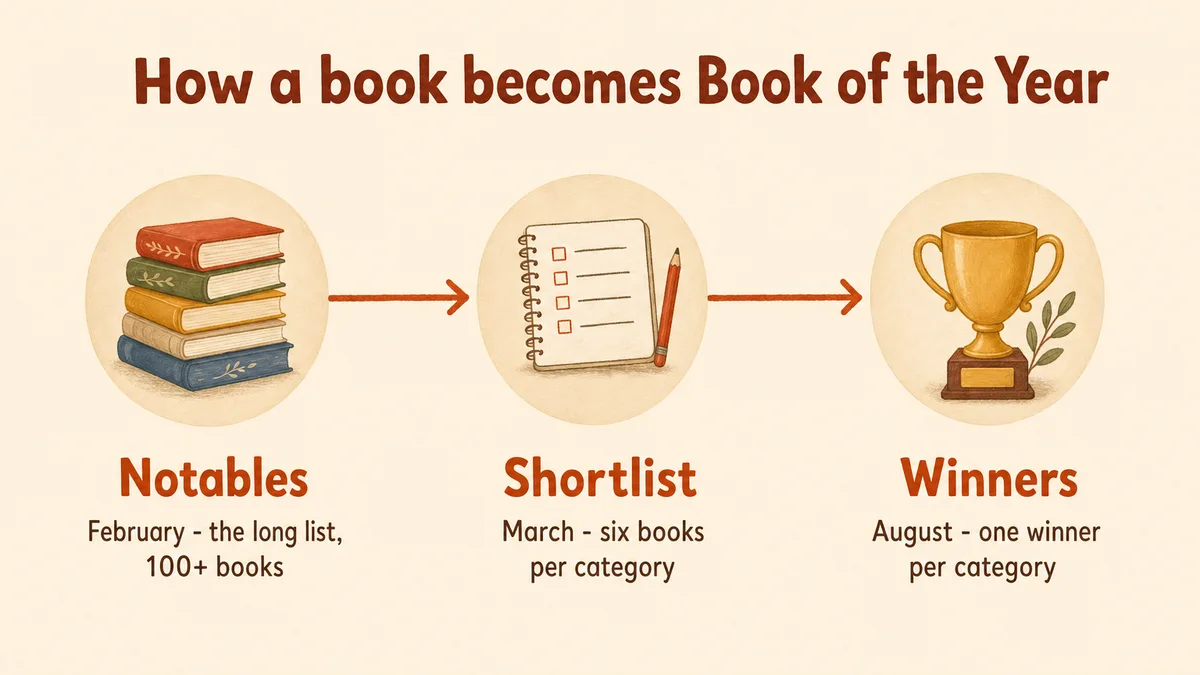 The field narrows in public, in three stages, across the year.
The narrowing happens in public, which is part of what makes the award useful to a parent. First come the Notables in February, a long list of the year’s strongest books, more than a hundred of them. Then the Shortlist in March, six books per category. Then the Winners in August, with one winner and two Honour Books named in each category.
So the sticker you see in a shop isn’t a single yes-or-no verdict. It’s the end of a year of reading by people who do this for the love of it. A shortlist sticker means the book cleared a bar that hundreds didn’t. A winner sticker means it was the one book in its category, that year, that a room full of expert readers couldn’t put down.
Since 2022 there’s been a second layer: Shadow Judging, where panels of actual children read the shortlist and pick their own favourites. The kids don’t always agree with the adults. That’s half the fun.
Why the awards matter to a parent
You’re standing in a bookshop with a fussy three-year-old and four minutes. You can’t read the back of every book. The CBCA sticker is the closest thing to a trustworthy filter you’ll get, and it costs you nothing to use.
It works because it cuts against the grain of how most books get in front of you. The books pushed hardest in shops are usually the ones with the biggest marketing spend behind them, tie-ins to a film, a TV character, a brand. The CBCA judges don’t care about any of that. They care whether the book is good. A small story from a publisher you’ve never heard of can beat a global franchise, and often does.
The award has also done real work shaping the canon. Dick Roughsey’s The Rainbow Serpent won Picture Book of the Year in 1976 and is still in print, still read in classrooms, nearly fifty years on. That’s the thing a marketing budget can’t buy: a book that’s still alive in two generations’ hands. A good chunk of the classic Australian children’s books parents reach for today carried one of these stickers first.
None of this means an un-stickered book is a bad book. Plenty of beloved titles never won a thing. Grug never has, and we’d never claim otherwise. The award is a strong signal, not the only one. But for a parent short on time, a strong signal you can read in two seconds from across a shop is worth a great deal.
Frequently asked questions
What does CBCA stand for?
CBCA stands for the Children’s Book Council of Australia, a not-for-profit organisation founded in 1945 that promotes Australian children’s literature. It runs the Book of the Year Awards and the annual Children’s Book Week. You can read more on the official site, cbca.org.au.
How many CBCA award categories are there?
There are six: Older Readers, Younger Readers, Early Childhood, Picture Book of the Year, the Eve Pownall Award for information books, and the Award for New Illustrator. Each has one winner and two Honour Books named per year.
When are the CBCA winners announced?
The winners are announced each August, during Children’s Book Week, which is held in the third week of the month. In 2025 the winners were announced on 15 August. The Notables list comes out in February and the Shortlist in March.
What’s the difference between the Shortlist and the Notables?
The Notables are the long list, usually more than a hundred books, named in February. The Shortlist is the cut-down list of six books per category, named in March. A book has to make the Notables before it can reach the Shortlist, and the Shortlist before it can win.
Are CBCA award-winning books worth buying?
For a parent who can’t read every book first, yes. A CBCA sticker means a panel of expert judges rated the book among the best of its year, judged on quality rather than sales or marketing. It’s not a guarantee your child will love a particular title, but the hit rate is high, especially in the Early Childhood and Picture Book categories.
A book award is only as good as the reading behind it, and the CBCA has eighty years of it. The sticker won’t tell you whether your own child will sit still for a particular book. What it tells you is that someone who reads hundreds of these a year thought this one was worth your time. That’s a better starting point than most.